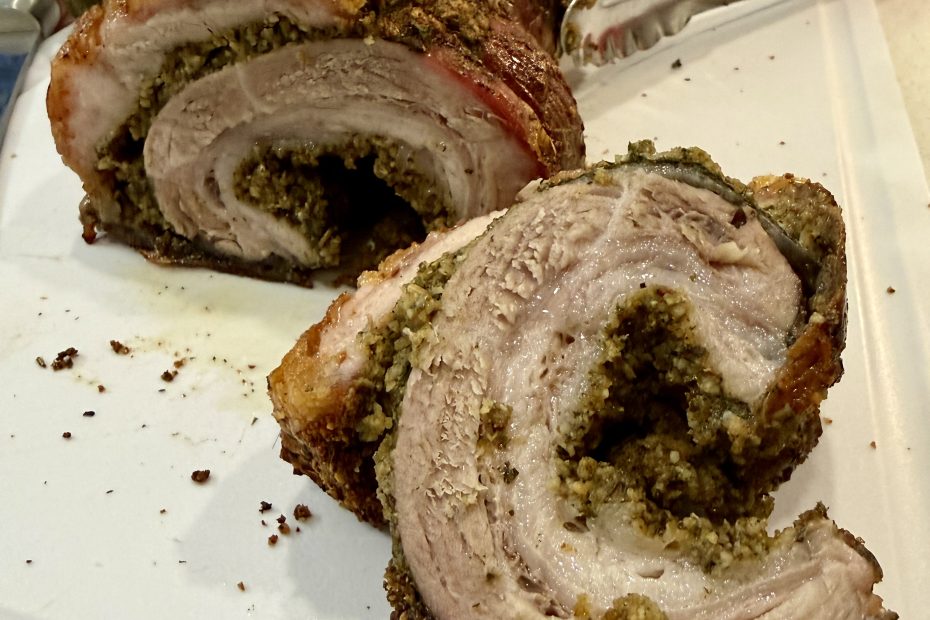
Porchetta with Salsa Verde

Our original porchetta was created for a 2-week health reboot class in January of 2021. One of the featured sessions in this reboot was a cooking class: we supplied the ingredients list ahead of time, and our participants cooked along with us as we demoed virtually. Always informative, fun and awfully great food.
We’ve walked past the porchetta that is being sold in the Costco coolers dozens of times. Each and every time we said, ‘They look good, but we’d much rather make our own. ‘— By making our own, we get to create the flavour profile we like, and we also control the ingredients — so this weekend we finally did.
We used about a third of a slab of the full belly, which we purchased when it was at 9.99/kg. It was a great price that would make a meal that is economical enough to feed a crowd.
Our first step was to butterfly and cut it ALMOST in half. You leave it connected and in one big, long piece so you can create the roll. Then we covered in plastic to pound it perfectly flat. Years ago we would have used a meat hammer, but these days we just use the bottom of a heavy pot and slam away!
If you have temperature probes, this is the perfect recipe to pull them out and put them to use. Our probes told us exactly when the internal temperature was where we wanted it. No guesswork involved.
The end result was frikkin gorgeous. We paired ours with a salsa verde, lotus root fries and a daikon slaw.
Convenience may be…well, convenient…but doing it the old-fashioned way brings great pleasure, and very happy tummies.
- Prep Time40 min
Ingredients
For the pork belly
- 1/2 full pork belly, 12x12 slab
- Salt
- Pepper
- Garlic Powder
- 1/2 cup parsley or other herbs, chopped
- Butchers' or kitchen twine
For the herb filling
- 1/4 cup almonds, skinned, we used slivered almonds
- 1/4 cup fresh parsley
- 1 tbsp fennel seeds
- 1 full head of garlic, peeled.
- 1 tbsp fennel seeds
- 1 tsp dried thyme
- 1/2 tsp sage
- 1/2 tsp Korean chilli flakes
- 1 tsp pepper
- 1 cup pork panko or crushed pork rinds
- 1/4 cup oil
For the salsa verde
- 1 cup fresh parsley leaves, chopped
- 1/2 cup fresh oregano leaves, chopped
- 2 tablespoons sage leaves, chopped
- 2 cloves garlic, chopped
- 2 tablespoons rice wine vinegar
- 1 tablespoon lemon juice
- 1/2 cup extra virgin olive oil
- 1 tablespoon chili flakes
- 1/2 teaspoon salt
- 1/2 teaspoon ground black pepper
Directions
To make the herb stuffing
Place all the stuffing ingredients into a blender or food processor.
Pulse until the mixture is finely chopped and turns into a paste. Set aside.
To make the pork belly
Prepare a baking sheet with a layer of foil and then a layer of parchment paper. This helps set you up for an easy cleanup.
Place the pork belly skin/fat side down on a cutting board or clean work surface. Using a sharp chef’s knife, filet the piece of pork belly by cutting it in half, but make sure to leave the very end uncut. This will allow you to flip the cut side back, creating one thinner and longer piece of pork.
If the meat has been cut unevenly, cover the pork with plastic and use the bottom of a pot or a rolling pin as a meat hammer to break down the meat fibres and flatten the meat to an even thickness.
Season liberally with salt, pepper and garlic powder, and rub into both sides of the meat. The amount that you use will be determined by the side of your piece of pork and your own flavour preferences.
Preheat the oven to 400°F.
Flip the pork belly over, keeping the fat or skin side down and spread the herb stuffing over the pork. Sprinkle a thick layer of the fresh herbs onto the herb mixture. We used a combination of parsley and fresh carrot tops.
Cut several lengths of butcher’s twine.
Starting with the side that is farthest away from the fat layer, carefully roll the pork belly. Flip the now rolled pork belly over to the fat side up and score the fat surface. Do not cut all the way through; our pork belly was 3/4 of an inch thick (after filleting), so we cut about 1/4-inch-deep incisions. The cuts should be about 1 inch apart.
When the porchetta is totally rolled, secure the roll with butcher/kitchen twine about every inch and a half.
Place the secured pork belly seam side down on the prepared baking sheet.
Rub any extra herbs or seasoning from your board onto the top of the porchetta
Place the roasting pan in the oven and roast the pork loin for 1 hour at 400°F to allow the outside to crisp. Then, drop the temperature to 300°F and continue cooking for 2 to 3 hours, or until the internal temperature reaches 185°F.
The outside of the porchetta should be good and crispy, but if you prefer it crispier, remove the porchetta from the oven and increase the oven temperature to 425 °F.
Return it to the oven for another 20 to 30 minutes, until the skin has crisped. Take caution that you don’t dry out the porchetta.
Allow the porchetta to rest 10 minutes while the internal temperature continues to rise to 190°F before slicing and serving. Using a serrated knife, cut through the crisp skin/fat into slices, about 1/2” to one inch thick.
Garnish with freshly minced parsley and lemon zest.
To make the Salsa Verde
Finely chop all ingredients and combine in a bowl, OR pulse all ingredients in a food processor until they become finely diced.
Reheat thin slices on a sheet tray with a small amount of water in the bottom, in an oven preheated to 325°F until heated through.
Pine nuts or pistachios can be used in place of almonds
Regular panko can be used in place of the pork panko.
Nutrition & Macro Information
- Amount per serving
- Calories0
- % Daily Value*


